 IntoSlides
Presentation example
Space exploration: a five-slide presentation
IntoSlides made this deck from one topic: “Space exploration: from the first satellite to rovers on Mars, for a middle school science class”. Below are all five slides with their text. Download the PowerPoint or make a presentation on your own topic.
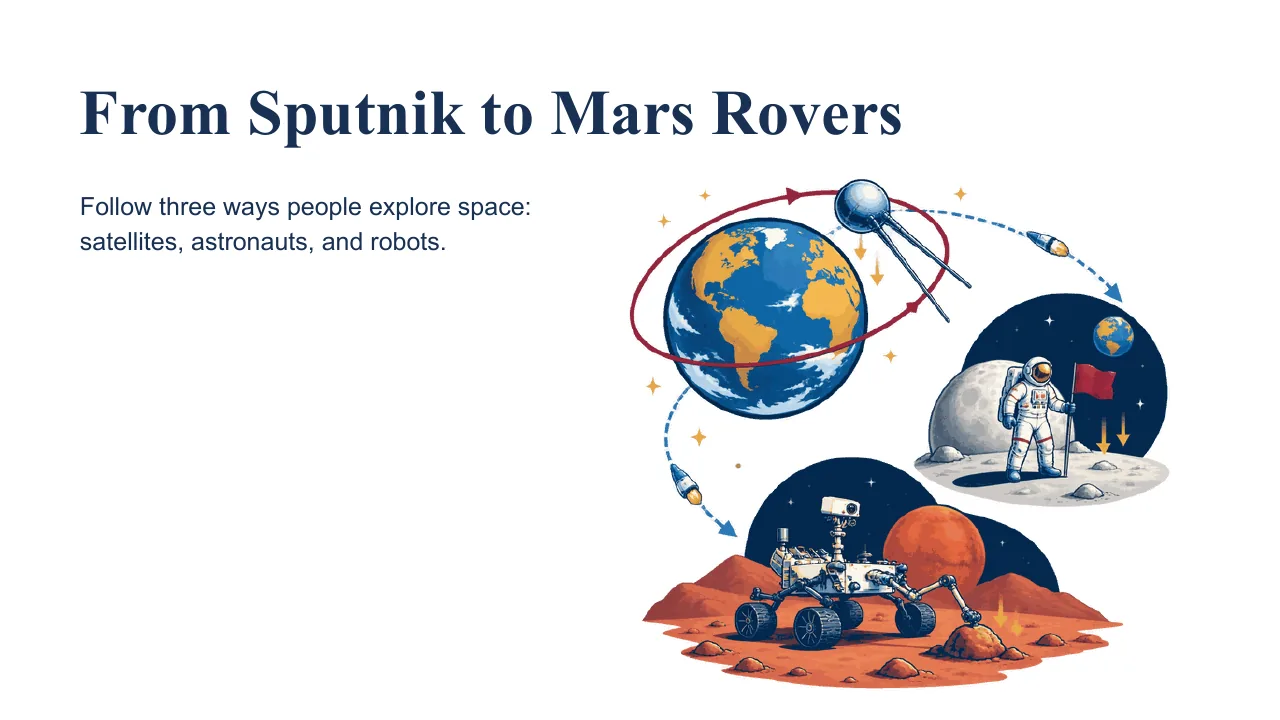
From Sputnik to Mars Rovers
Follow three ways people explore space: satellites, astronauts, and robots.
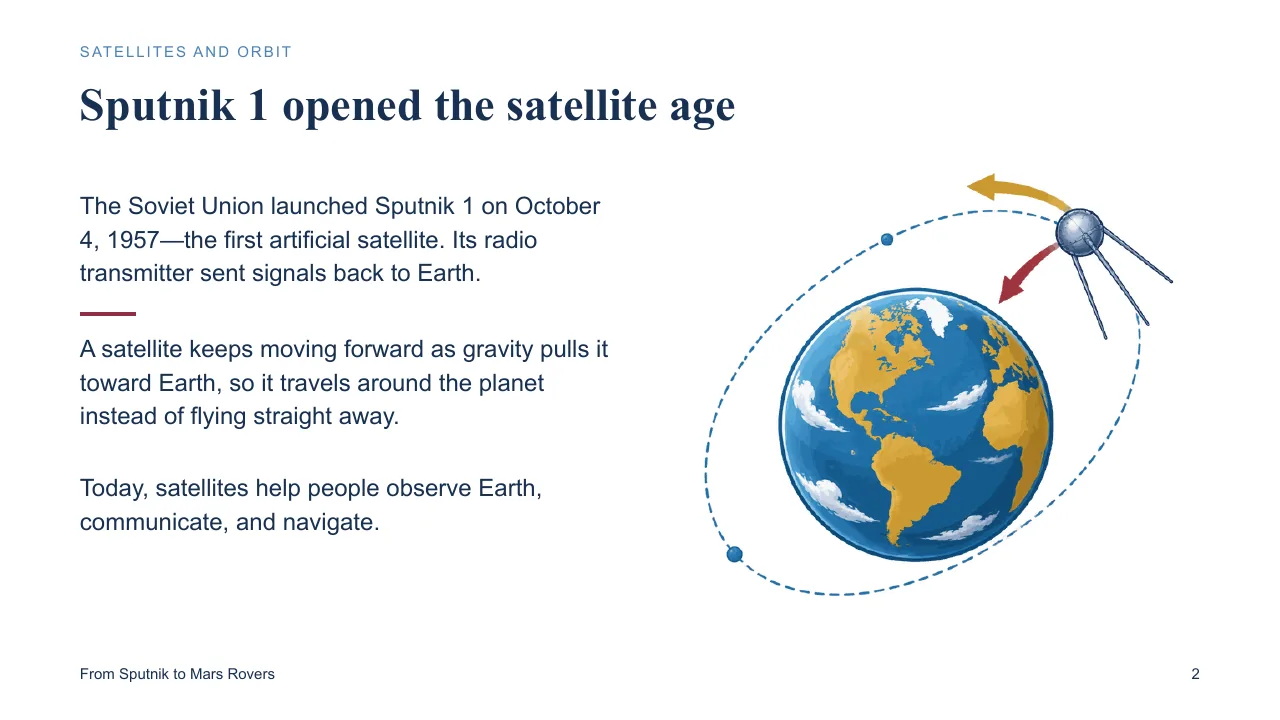
Sputnik 1 opened the satellite age
The Soviet Union launched Sputnik 1 on October 4, 1957—the first artificial satellite. Its radio transmitter sent signals back to Earth.
A satellite keeps moving forward as gravity pulls it toward Earth, so it travels around the planet instead of flying straight away.
Today, satellites help people observe Earth, communicate, and navigate.
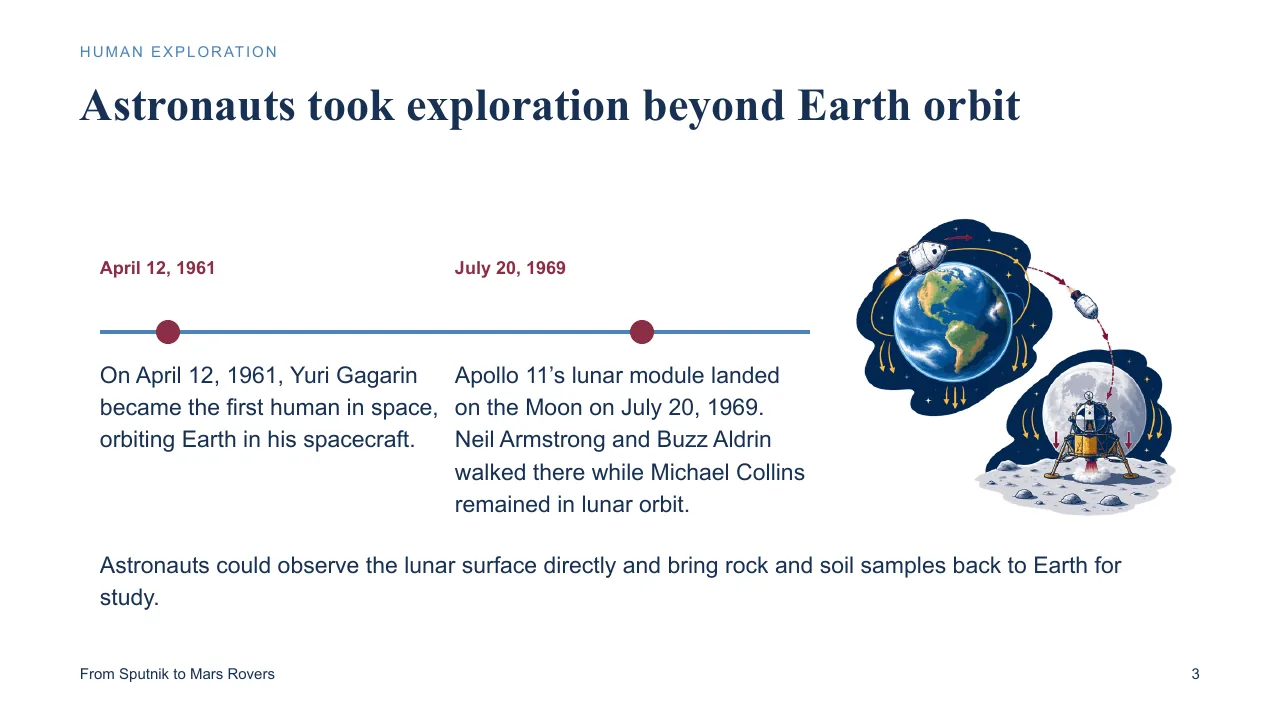
Astronauts took exploration beyond Earth orbit
On April 12, 1961, Yuri Gagarin became the first human in space, orbiting Earth in his spacecraft.
Apollo 11’s lunar module landed on the Moon on July 20, 1969. Neil Armstrong and Buzz Aldrin walked there while Michael Collins remained in lunar orbit.
Astronauts could observe the lunar surface directly and bring rock and soil samples back to Earth for study.
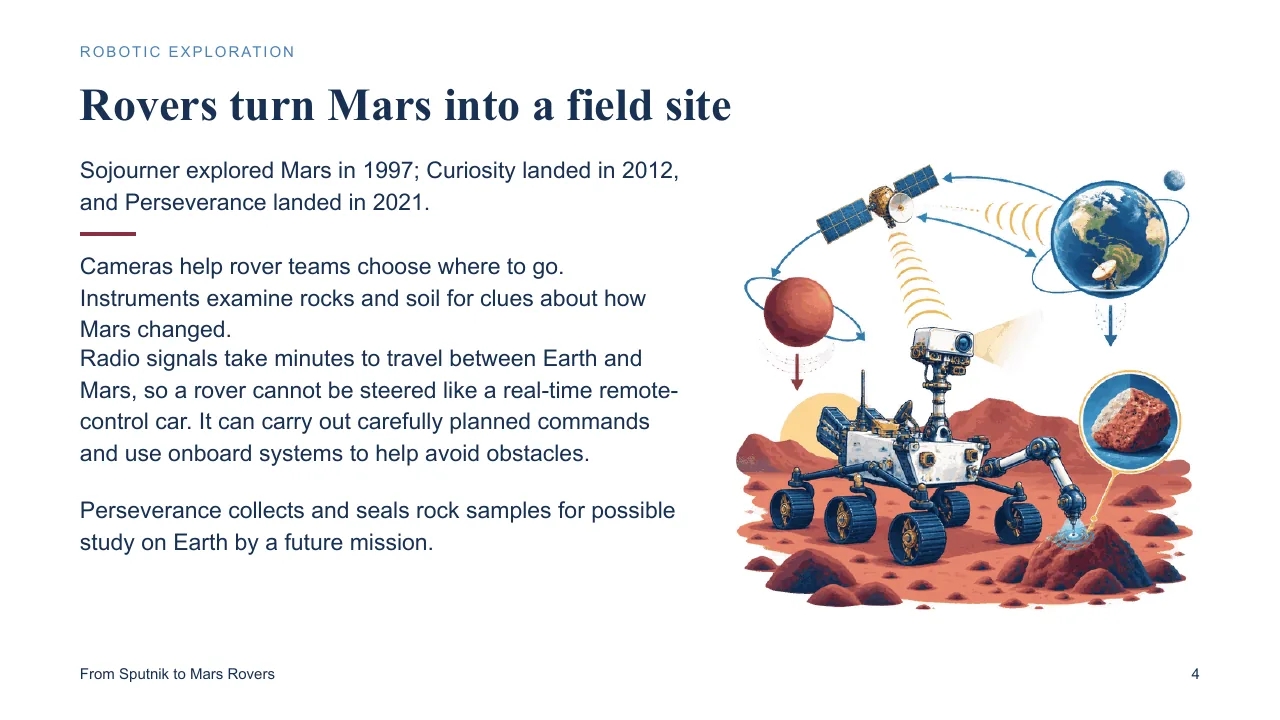
Rovers turn Mars into a field site
Sojourner explored Mars in 1997; Curiosity landed in 2012, and Perseverance landed in 2021.
Cameras help rover teams choose where to go. Instruments examine rocks and soil for clues about how Mars changed.
Radio signals take minutes to travel between Earth and Mars, so a rover cannot be steered like a real-time remote-control car. It can carry out carefully planned commands and use onboard systems to help avoid obstacles.
Perseverance collects and seals rock samples for possible study on Earth by a future mission.
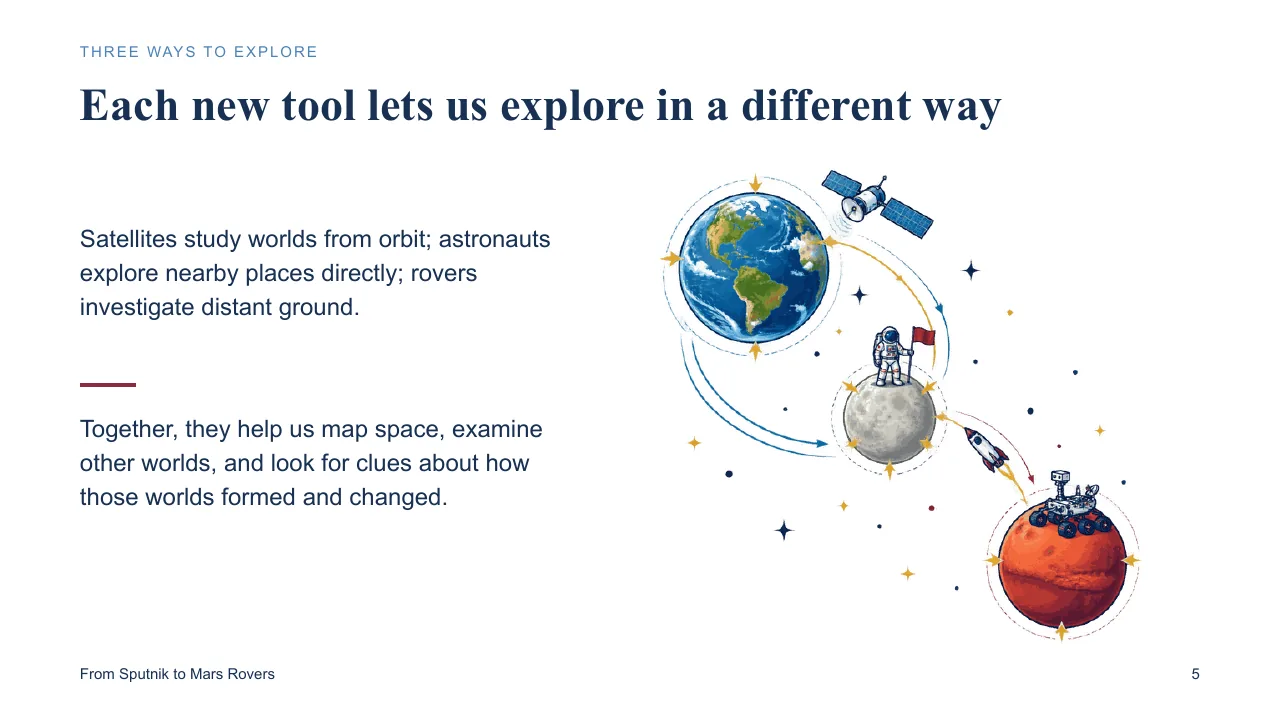
Each new tool lets us explore in a different way
Satellites study worlds from orbit; astronauts explore nearby places directly; rovers investigate distant ground.
Together, they help us map space, examine other worlds, and look for clues about how those worlds formed and changed.
 Electricity
 The American Revolution
 The American Civil War